

Incessant Crescent
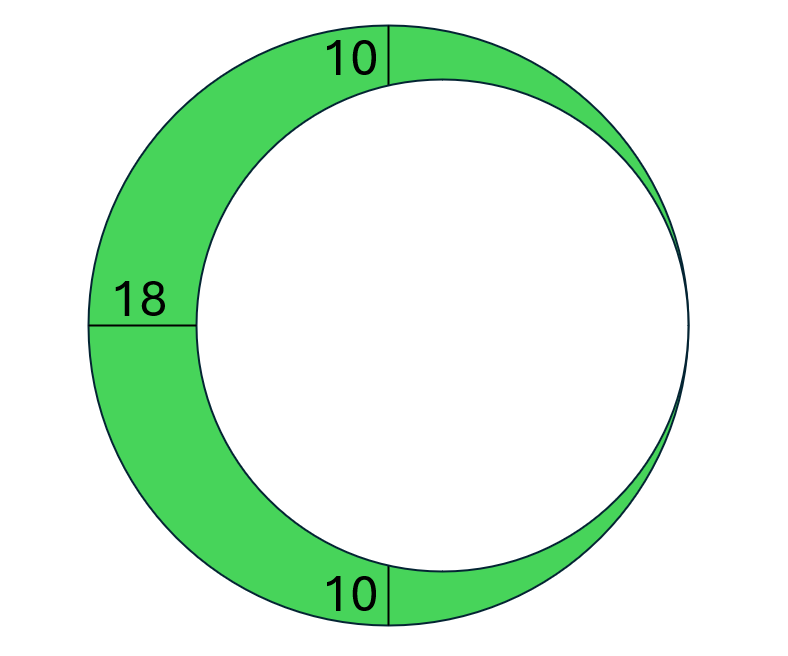
Determine the area of the green shaded portion of the diagram, given only the lengths of the three chords on the major axes of the larger circle.
Demonic Ultrasonics
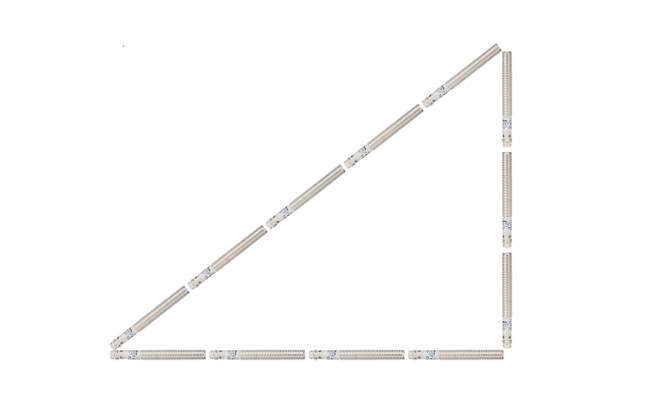
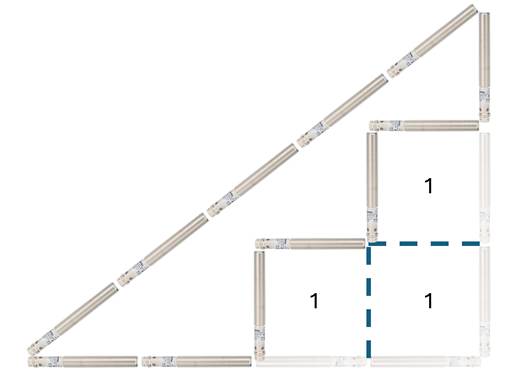
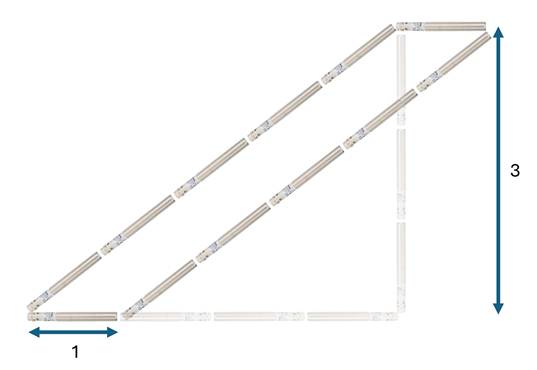
Twelve di-soric® Ultrasonic Proximity Sensors have been laid out in a familiar “3-4-5” triangular pattern, such that the bounded area of the right triangle is 6 (square units). The first challenge is to move four, and only four, sensors to change the bounded area to exactly 3 square units. Extra credit: starting from scratch, move any of the sensors except the diagonal row of five to create a different shape with an area of exactly 3 square units.
Did you know… that AutomationDirect now offers a complete line of di-soric IO-Link Compatible Ultrasonic Sensors. di-soric 8, 12, 18, and 30mm tubular and 12mm rectangular ultrasonic proximity sensors are designed for contactless distance measurement and offer IO-Link with ISDU support, a rugged nickel-plated brass construction, high IP67 protection ratings, and sensing distances up to 6,000mm. ISDU (Indexed Service Data Unit) provides on-demand exchange of parameter data (identification, configuration, and diagnostics) between the IO-Link master and the connected device to ensure accurate measuring. Learn More!
Bubble Trouble
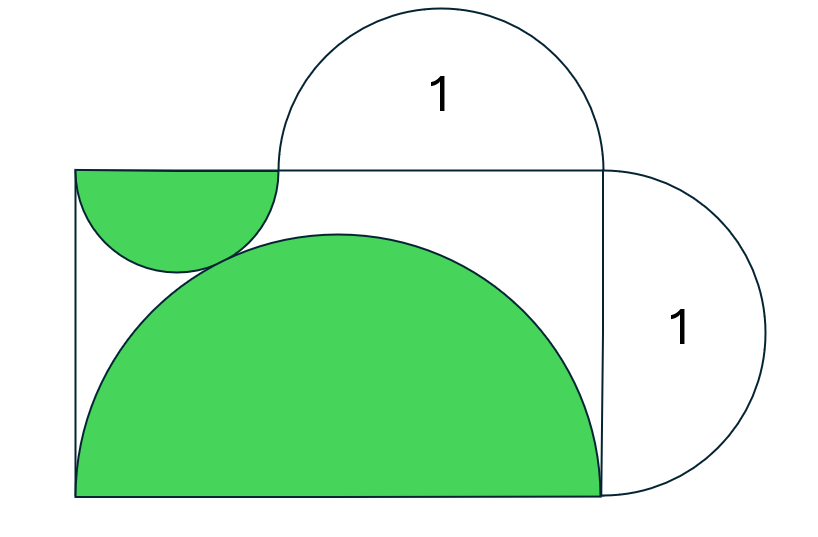
Find the combined area of the green shaded semicircles in the figure below, given only the two semicircular areas shown.
Answers Below!
.
.
.
.
.
.
.
Incessant Crescent
Let’s add a few additional line segments and label them with simple formulas where possible:
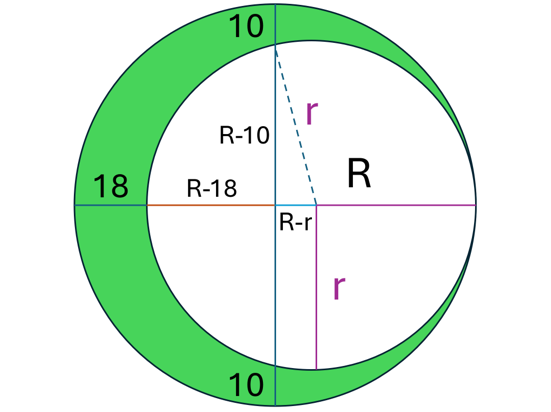
If we assign “R” to be the radius of the large circle and “r” to be the radius of the small circle, then on the middle horizontal line we can see that:
2R-2r=18
R-r=9 [We will use this below, and substitute in the image]
R=r+9 [And also this]
Now, let’s focus on the right triangle in the middle:
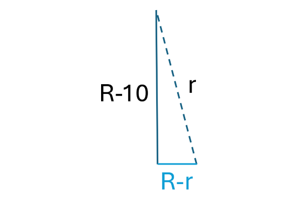
We already know that R-r= 9 (triangle base) and we can substitute r+9 for R on the vertical side (R-10=r+9-10=r-1):
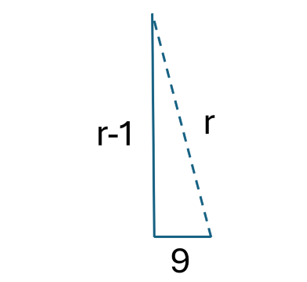
That (and Pythagoras) will allow us to set up this equation (and solve for “r”):
(r-1)2 +92 =r2
r2-2r+1+81= r2
-2r+82=0
-2r=-82
r=41
Substitute for r in our previous equation (to solve to R):
R=r+9
R=41+9
R=50
And it is a simple matter to solve for the area of the green shading:
Agreen= R2 –
r2
=502– 412
=(2500-1681)
=819
Demonic Ultrasonics
For the first solution, move the four sensors in the bottom right corner up and over as shown. Starting with an area of 6, the three 1-unit squares we have excluded result in a new bounded area of 3 units.
For the extra credit, move the sensors as shown to create a parallelogram. (The area of a parallelogram is equal to its base length times its height)
Bubble Trouble
Let’s assign “r” as the radius of the two white semicircles, “R” as radius of the large green semicircle, and “ρ” as the radius of the small green semicircle, and label a few other “givens”, once we’ve made those assignments. (Note that The Theorem of Touching Circles states that if two circles touch each other, their point of contact and their centers lie on the same straight line.)
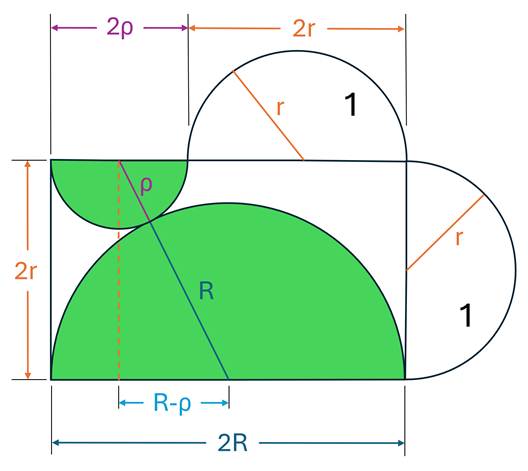
We know the area of the white semicircle is 1, so let’s start by solving for r2:
1/2 (πr2) = 1

(We could go further, but as you will see, r2 is good enough)
We can also see from the top and bottom of the square portion of the figure that:
2R = 2ρ+2r
R = ρ + r
Or put another way:
r = R – ρ
Substituting from above:
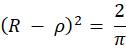
Now let’s focus on the right triangle
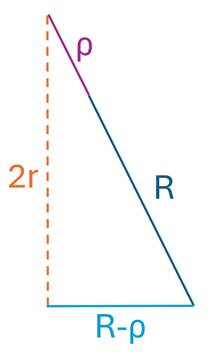
We can write the equation:
(2r)2 + (R – ρ)2 = (R + ρ)2
We are going to solve this equation in two ways; first:
4r2 + R2 – 2Rρ + ρ2 = R2 + 2Rρ + ρ2
4r2 + R2 – 2Rρ + ρ2 = R2 + 2Rρ + ρ 2
4r2 = 4Rρ
r2 = Rρ
Now let’s solve it again, but remember that we already determined that r = R – ρ
So we can substitute that into (2r)2 + (R – ρ)2 = (R + ρ)2 , like this:
(2r)2 + r2 = (R + ρ)2
4r2 + r2 = R2 + 2Rρ + ρ2
Now substitute in r2 = Rρ
4r2 + r2 = R2 + 2r2 + ρ2
And simplify:
3r2 = R2 + ρ2
Now remember at the start, we determined:

Substitute that in for r2
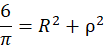
(we’re about to land this plane… I promise)
Now let’s note that we are looking for the area of the two shaded semicircles:
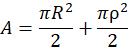
We can rewrite that as:
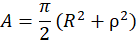
And substitute from above:

Therefore, the area of the green shaded semicircles = 3