

For decades, ladder logic has been the undisputed leader as a PLC programming language, but today’s controls engineers are taking greater advantage of another option, structured text, for advanced applications incorporating data handling, communications, recipe management, and more.
By Tim Ensminger, AutomationDirect
Programmable logic controllers (PLCs) have served as the preferred machine and factory automation platform for decades. Even though ladder logic (LD) was an original programming language, this method has typically remained as the default approach. However, as automation systems have grown more complex and data-intensive the use of structured text (ST) has increased, not as a replacement, but as a complement. The following information looks at the strengths and weaknesses of LD and ST, to provide some guidance for those developing new projects.
Ladder logic – the historical standard
In the 1960s and 1970s, LD running on PLCs emerged as a direct digital replacement for hardwired relay panels. This combination has dominated the industrial automation market for several reasons:
- Designed for the audience. LD mimics drawing-based relay schematics such as contacts, coils, and wiring rungs — the same visual language already used by electrical technicians and engineers, so no new mental model was required.
- Debugging in place. PLCs display live ladder diagrams via the programming software, highlighting which contacts are energized in real time for classic discrete logic, so a technician can visualize execution.
- Inertia and trust. Industries like automotive, food processing, and utilities have built decades of proven code, training programs, and certifications around ladder logic.
Structured text
First published in the 1990s, IEC 61131-3 defined several PLC programming languages, one of them being ST which is a high-level text-based language beneficial for:
- More complex machines. Modern automation involves motion control, data handling, recipe management, and networked systems. Loop-heavy or math-intensive logic written in ladder quickly becomes complex and unwieldy, while ST handles these functions more naturally.
- A new generation of engineers. Graduates entering automation already know C, Python, or MATLAB, so ST’s syntax (similar to Pascal/C) feels more familiar to them than LD.
- Better tool support. Modern IDEs now offer ST editing with auto-complete syntax, version control integration, and unit testing.
Why program with ladder logic or structured text?
This table summarizes the strengths and weaknesses of LD and ST.
| Ladder Logic | Structured Text | |
| Strengths | Designed for the audience; visual relay-style logic diagram familiar to electriciansLive rung-by-rung debugging built inDecades of proven legacy code | Designed for programmers; handles loops, math, and arrays cleanlyReusable functions and function blocksFamiliar to a new generation of software engineers, and works well with Git and version control |
| Limitations | Scales poorly with complex logicWeak data handling and math supportMinimal code reuse or abstraction | Steeper curve for electricians tasked with supporting operationsLess visual, harder to trace live conditionsOverkill or a poor fit for simple tasks |
| Best For | Standard LD programming remains popular and effective for discrete I/O handling, simple sequencing, and legacy maintenance. | ST programming is the best choice for many advanced applications such as motion control, data processing, and complex sequencing. |
Examples of LD and ST code
Example 1 — Motor Start/Stop with Seal-In
This is the classic use case LD was created for. A seal-in circuit (also called a latch circuit) holds a motor running after a momentary start button is released and stops it when a stop button or overload trips. LD is the better choice here, while ST is possible, but awkward.
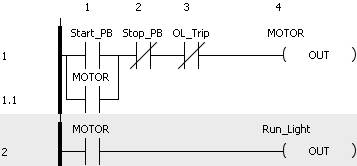
Figure 1. This is a relay schematic in digital form. The seal-in contact is self-documenting. Live highlighting shows exactly which contacts are closed at runtime.
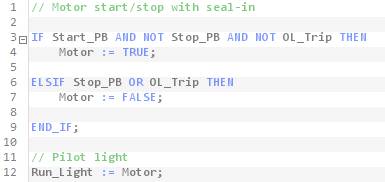
Figure 2. The ST version works, but the seal-in behavior — a fundamental safety concept — is implicit. An electrician reviewing this code may miss that Motor retains state between scans. The relay analogy is lost.
Example 2 — Analog Scaling and Alarm Banding
This example shows where ST earns its keep. Scaling a raw analog signal to engineering units and applying alarm bands with hysteresis is possible but painful in LD, requiring multiple rungs/branches, while in ST the entire block lives in roughly 15 readable lines, making this the better choice.
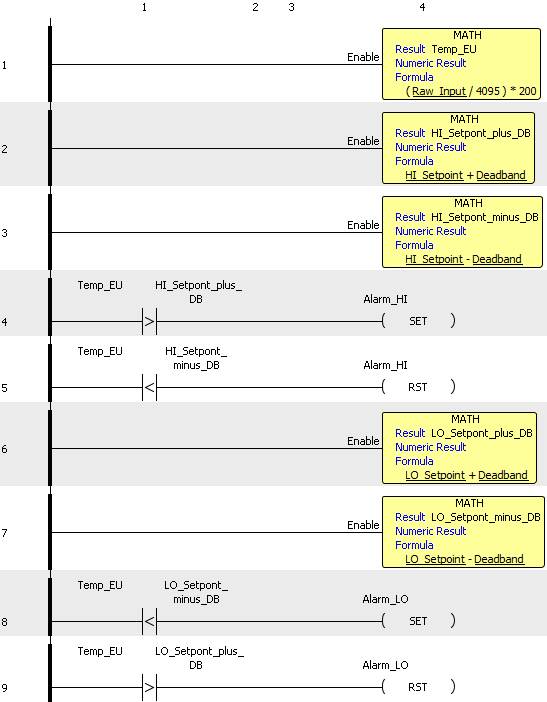
Figure 3. Each LD math or compare operation needs its own rung and the logic.
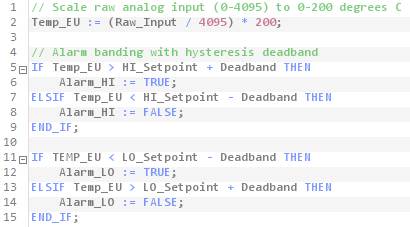
Figure 4. The scaling formula and alarm logic are co-located and readable in one block. Hysteresis (deadband) is expressed naturally with ELSIF — no extra rungs needed.
So, should I use LD or ST to program my PLC?
Ladder logic and structured text are not rivals — they are complementary tools. The most capable controls engineers today are fluent in both. They let the nature of the problem — not habit or preference — decide the language used.
They write motor interlocks in LD because when a technician needs to troubleshoot a tripped motor circuit at 2AM, a live ladder diagram is worth more than any amount of elegant text-based code. They write analog scaling, alarm management, and motion logic in ST because that’s where text-based code earns its keep.
The question is no longer “ladder or text.” It’s knowing, for any given block of logic, which language makes the intent obvious to the next engineer who opens the file. Write for both the application and the maintainer, using both LD and ST.
Figures all courtesy of AutomationDirect unless otherwise noted
About the Author

Tim Ensminger is a product manager at AutomationDirect. During his 20-year career, he worked primarily in the petroleum transportation industry designing and commissioning.