

The AutomationDirect BRX PLC incorporates capabilities essential for this software services company to create a reliable SCADA solution tailored for municipalities.
Massive metropolises and humble hamlets both depend on reliable water and wastewater treatment facilities. In the United States, some estimates indicate that relatively few large systems may serve about 80% of the population, while about 90% of the systems are considered small (serving 10,000 or fewer people) and handle the rest of the population. Treatment plants of all sizes may use some similar mechanical and control technologies, and although they operate at extremely different scales they have distinctly different budgets with which to procure automation technologies and employ workers.
Recognizing this disparity, one software development company set out to create an easily used supervisory control and data acquisition (SCADA) platform tailored to support the highly exposed, but often neglected, area of rural municipal water operations, with both affordability and cybersecurity in mind.
Greg Martz, the founder of CoStream, was well acquainted with the characteristics such a platform would require. He had already built a traditional industrial automation systems integration firm over more than two decades, eventually selling it to his employees.
To successfully serve small municipalities, the CoStream SCADA platform would need to:
- Easily integrate with legacy technologies
- Support the requirements of new facility installations
- Work agnostically with any automation platforms, primarily by supporting standard industrial communication protocols such as EtherNet/IP, Modbus TCP, MQTT, OPC UA, and others
- Be remotely supportable, and substantially integrated with the cloud, so that end users could leverage the skills of remote trained personnel, like having access to a fractional operations technology (OT) engineer
- Incorporate appropriate cybersecurity measures
With regards to cybersecurity, while every vulnerability is a “bug”, not every bug is a vulnerability. Furthermore, the skill level of any “hacker” seeking to compromise a system may be characterized somewhere in a range that includes unaware participant, solo actor, corporate-level, or state-run; and now each of these levels can use AI-accelerated methods. However, any developer of digital and networked technologies strives to squash bugs and eliminate vulnerabilities.
Recently, CoStream created a demonstration installation of their SCADA platform as a penetration testing challenge, and openly invited people to attempt to hack into it. Many tried, but nobody succeeded in winning the $5,000 prize (although Martz donated $5,000 to the Tunnel to Towers Foundation anyway), demonstrating that the company had met it’s cybersecurity goals for this application.
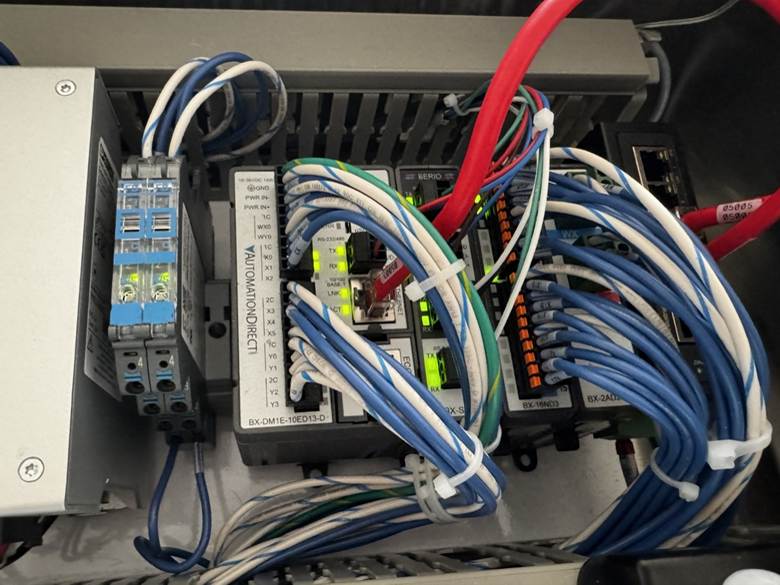
While the complete solution incorporates a stack of many technology layers, the team at CoStream selected the AutomationDirect BRX stackable micro brick PLC platform as the preferred on-premises element. The BRX is a powerful and capable PLC, programmed with the free Do-more Designer software, which includes a simulator. A wide array of traditional I/O modules and hot-swappable communications ports are available, and the BRX is also notable for the multitude of communications protocols it supports, making it ideal for seamless integration with plant-level OT devices, high-level information technology (IT) systems, and with industrial internet of things (IIoT) and cloud-based platforms (Figure 1).
AutomationDirect has a long history of providing capable and cost-effective automation technologies, and supporting all types of users and applications, so it makes sense that the BRX PLC is such a good fit as part of a solution to empower small municipalities.