

A new class of edge-optimized Ethernet switches are purpose-built for industrial environments and protocols, providing a streamlined approach for connecting valuable OT data with enterprise IT resources for improved visibility, analytics, and proactive diagnostics.
By Damon Purvis, AutomationDirect
Throughout all aspects of industrial automation, the historical separation between operational technology (OT) and information technology (IT) connectivity is rapidly disappearing. Business environment IT networks have primarily focused on scalability, segmentation, and data accessibility, while networking technology applied to OT applications was engineered for robust and deterministic performance among PLCs, remote I/O, HMIs, and other devices.
However, industrial end user requirements have shifted in recent years to prioritize more enterprise-centric capabilities for remote connectivity, analytics, artificial intelligence (AI), and other needs that all depend on reliable access to machine and process data. As a result, designers are seeking OT network architectures that preserve control performance at the machine level, while exposing operational data to higher-level IT systems in a secure and manageable way, with solutions that:
- Enable secure plant-to-enterprise data sharing
- Support industrial protocols and IT network standards
- Preserve deterministic behavior while improving visibility
- Minimize the management burden while maintaining fault tolerance
The challenge for both OT and IT personnel is to find effective products and strategies for bridging the two domains, with unmanaged+ industrial Ethernet switches a leading solution.
A Delicate Balancing Act
In many facilities, neither OT or IT teams have the time or staffing to fully engineer and maintain a heavily managed industrial network at every machine or cell. This creates demand for edge devices that can enforce essential traffic controls and diagnostics without requiring full IT-style configuration workflows.
To address these and related issues, industrial edge switches can fill the gap between basic unmanaged switches and fully managed enterprise infrastructure. The objective is not to replicate the entire IT feature stack at the machine level, but to instead only expose features that matter most in industrial applications, using a deployment model familiar to OT personnel. Some edge switches, usually referred to as lean or lightly managed, take on this task but still require some degree of software configuration.
However, there is another category of switch that avoids software settings and instead relies on a plug-and-play design using DIP-switches for provisioning selective capabilities. A representative example is the AutomationDirect Stride PRO industrial unmanaged+ Ethernet switch family. These devices are specifically engineered to work with PLCs, HMIs, VFDs, and distributed I/O, while delivering IT-friendly capabilities. They provide a practical upgrade path from legacy architectures to modern Ethernet-based technologies (Figure 1).
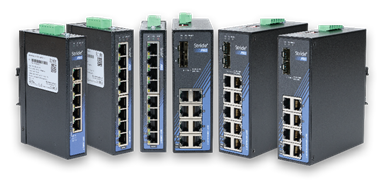
From a hardware perspective, unmanaged+ switches must be designed for industrial service: DIN-rail or panel mounting, metal enclosures, 24 VDC operation, extended temperature tolerance, and strong immunity to electrical noise, surge, reverse polarity, and power anomalies. Those requirements are not optional in control cabinets or field enclosures where commercial office-grade switching hardware is likely to underperform or fail prematurely. But the unique advantage is how they incorporate essential IT networking features.
Merging OT and IT
Network segmentation is useful for managing devices, traffic, and cybersecurity risks. Business IT commonly uses virtual local area networks (VLANs) and policy-based controls on managed switches to do this. On the factory floor, OT has historically achieved similar separation with physically distinct networks and simple switching to contend with multicast traffic from EtherNet/IP scanners and time-sensitive remote I/O communications, for example (Figure 2).
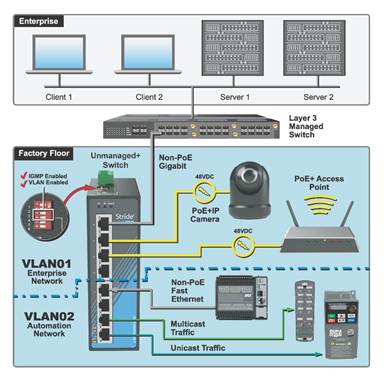
Unmanaged industrial edge switches allow these approaches to converge by adding just enough intelligence to manage traffic flows without overcomplicating support. Software configuration, extensive planning, and other management headaches are avoided, shortening initial deployment times and simplifying any subsequent troubleshooting.
Core Capabilities That Matter For OT
Key capabilities of unmanaged+ switches include Fast Ethernet and Gigabit uplinks, copper and fiber connectivity, and small form-factor pluggable (SFP) support for longer-distance or electrically noisy installations. Power over Ethernet (PoE), PoE+, and PoE++ reduce installation cost by delivering power and communications over a single cable to edge devices such as cameras, wireless access points, and selected industrial endpoints. Quality of service (QoS) helps prioritize time-sensitive control traffic, while broadcast storm protection limits abnormal traffic conditions that could interrupt automation processes.
Protocol-aware traffic handling is equally important, and the unmanaged+ switches are tuned to prioritize industrial protocols such as EtherNet/IP, PROFINET, Modbus TCP, and others. Internet Group Management Protocol (IGMP) snooping controls multicast distribution so that only subscribed ports receive the traffic, while port-based VLANs create isolated broadcast domains without requiring a fully managed switching architecture at every level of the control system. Port mirroring provides nonintrusive packet visibility for diagnostics, cybersecurity monitoring, and commissioning. A dedicated port disconnect alarm accelerates fault isolation for failed devices, loose connectors, and damaged cabling (Figure 3).
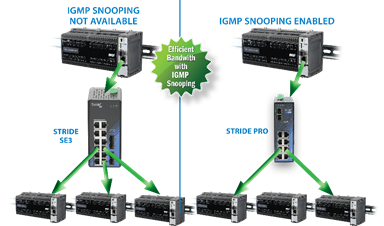
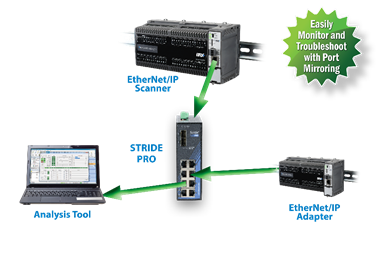
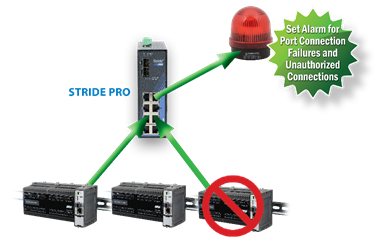
Figure 3: AutomationDirect Stride PRO industrial unmanaged+ Ethernet switches incorporate IT tools like IGMP snooping and port mirroring, along with more OT-focused options such as port disconnect alarms.
For OEMs and manufacturers, the network edge has become a strategic control and monitoring point. Remote diagnostics, condition monitoring, machine learning, and enterprise visibility all depend on trustworthy access to production data, yet none of these initiatives can come at the expense of real-time control determinism and stability. Industrial unmanaged+ switches address these and related requirements by combining OT-grade robustness with the specific IT-derived services needed to move data safely and efficiently across domains.
All figures courtesy of AutomationDirect
About the Author

Damon Purvis is the PLC Product Manager at AutomationDirect.com. He has over two decades of industrial automation experience. Previous roles have included designing and deploying automated solutions in a variety of industries, and managing product development of manufacturing data management and business intelligence applications.