

How a main-street innovation center is helping small-town utilities, students, and researchers get comfortable with industrial controls.
By: Greg Martz, CoStream
Small municipal water and wastewater systems are among the quietest success stories in American infrastructure. Some estimates suggest that about 90% of the water systems in the United States fall into the “small” category, serving 10,000 or fewer people, and together they are responsible for providing clean water to a meaningful portion of the population every day. Large metropolitan systems tend to get the attention, and the budgets, but the small systems do the quiet work of keeping countless communities running.
With this in mind, CoStream was founded in 2014 to provide collaborative support especially aimed at smaller municipal operations, with a unique delivery model. Like the fractional chief financial officer (CFO) concept familiar in the financial world, where an experienced executive works part-time to support several small companies that otherwise couldn’t afford and don’t need a full-time person in the role, CoStream offers a fractional OT engineering service. It gives small utilities access to experienced integration and cyber security professionals without the cost of a full-time hire. Beyond that, however, the CoStream team cultivates a passion for passing on knowledge.
After years of working with small utilities a similar pattern emerges: small teams, existing and often legacy equipment, tight budgets, and a persistent knowledge gap between the automation technology in the field and the staff expected to keep it running. Many of the operators understand how their equipment is operating, but few truly understand why something functions the way it does, and knowing the why is what makes someone effective at troubleshooting. Closing the knowledge gap is a big part of CoStream’s mission to provide hands-on education and support, not only for small municipalities but the community at large.
The work happens in a remodeled innovation center on the main street of a small town, behind a wall of glass windows. The community is proud of the space, and rightly so. Inside is a working test lab that serves as the backbone for training classes, academic research, and product development . It’s an environment where operators, students, and engineers can put hands on real, live equipment, experiment, and gain real-world experience without worrying about bringing down a critical system in the process (Figure 1).
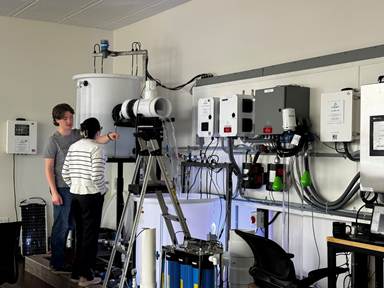
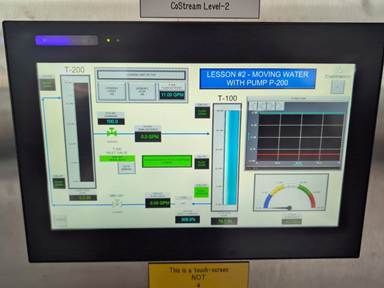
Figure 1: At the heart of the training center is hands-on test lab that includes a variety of equipment typically found in a water treatment facility, with a majority of devices sourced from AutomationDirect. The components are connected with clearly visible wiring and transparent piping, giving learners a clear picture of what’s going on inside the system.
The Knowledge Gap in Small-Town Utilities
Technicians at a small municipal utility tend to be multidisciplinary. The same person will typically address mechanical repairs, chemistry questions, or public works issues on any given day. Of all the skills the job demands, the ones that are most often underdeveloped are those involving electrical controls, automation technology, and information technology (IT). Not for lack of interest, but due to how little structured training these operators have historically had access to.
The result shows up consistently in classes. The single most common question from students is “how do I use a multimeter?”. It isn’t a sign of poor hiring or lack of aptitude, but rather that a large portion of essential workers have been handed complex instruments, programmable logic controllers (PLCs), human-machine interfaces (HMIs), supervisory control and data acquisition (SCADA) systems, and more, without ever being shown in a hands-on setting how any of it is supposed to work, let alone how to troubleshoot the issues that inevitably come with them.
Cybersecurity is another area where small utilities particularly are exposed and lacking in practical knowledge. Although headlines focus on state-level actors and sophisticated external attacks, some industry observers estimate that the majority of operational technology (OT) cyber incidents actually originate inside the fence from unauthorized physical access, shared credentials, or devices that were never properly secured in the first place. Small utilities very rarely have dedicated OT cybersecurity staff and feel this risk acutely.
A Space Built for Learning and Automation
CoStream’s answer for filling the knowledge gap was to build a physical space for automation education and experimentation, and to open it up to as many people as possible. The innovation center was designed around the idea that students learn best when they can touch the equipment, adjust parameters, take measurements, and see what happens in real time.
Comprising the test lab is a large set of equipment that might be found in a typical water treatment facility. On it, you’ll find modulating valves, variable frequency drives (VFDs) operating electric motor-driven pumps, level transducers, flow meters, tanks, filters—the works. All of these are connected using transparent piping so the students can actually see what’s happening inside, giving them an intuition for the effects the electrical controls are having on a system. Wires are intentionally routed to allow trainees to practice using clamp-on meters and see exactly how power and control signals relate to each device (Figure 2).
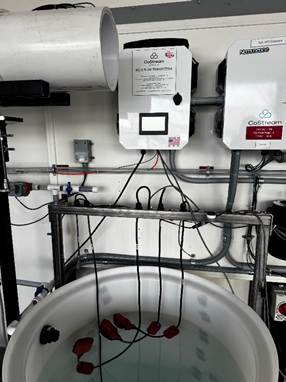
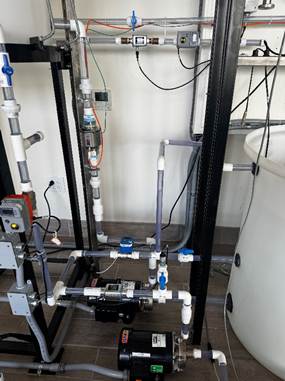
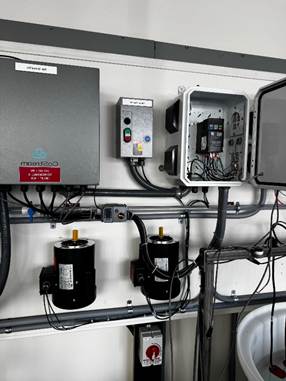
Figure 2: The test lab brings together hardware a typical small utility would encounter: (a) A flow transmitter and tank with float sensors, (b) transparent piping that lets students see water flow in real time, and (c) motors with their wiring routed for easy access with a clamp meter and a VFD to run them.
The Hardware Behind the Lab
The choice of equipment for the test lab mattered a great deal, because it must be reliable enough to support real training and research, and it needs to represent hardware that end users will actually encounter (or can realistically afford) in their own facilities. CoStream is hardware agnostic in client work; if a utility has an installed base of a particular PLC brand, the goal is to work with what is already there. But when building out the lab and recommending equipment for greenfield projects, AutomationDirect products have become the preferred choice.
There are two main reasons for this. The first is durability and longevity. The products have been around long enough to establish a track record in the field. The second is cost, specifically software cost. Small municipalities are deeply cost-conscious, and the prospect of paying thousands of dollars for programming software, then paying again every year to renew the license, is often a nonstarter. AutomationDirect’s free programming software removes that obstacle entirely.
The test lab itself is built around an AutomationDirect BRX PLC paired with a C-more HMI. The BRX is programmed with the free Do-more Designer software, and its broad support for industrial communication protocols makes it straightforward to integrate with the various field instruments on the lab. CoStream also regularly uses AutomationDirect Productivity series PLCs. Process instruments and devices include an Endress+Hauser Picomag magnetic flow meter with a Bluetooth interface, an ultrasonic level transmitter, modulating control valves, and multiple VFD-driven pumps driving water through a piping loop. In the controls cabinet, the wiring is even intentionally messy to a degree, simulating real-world conditions since, unfortunately, controls cabinets with beautifully routed wiring are in the minority (Figure 3).
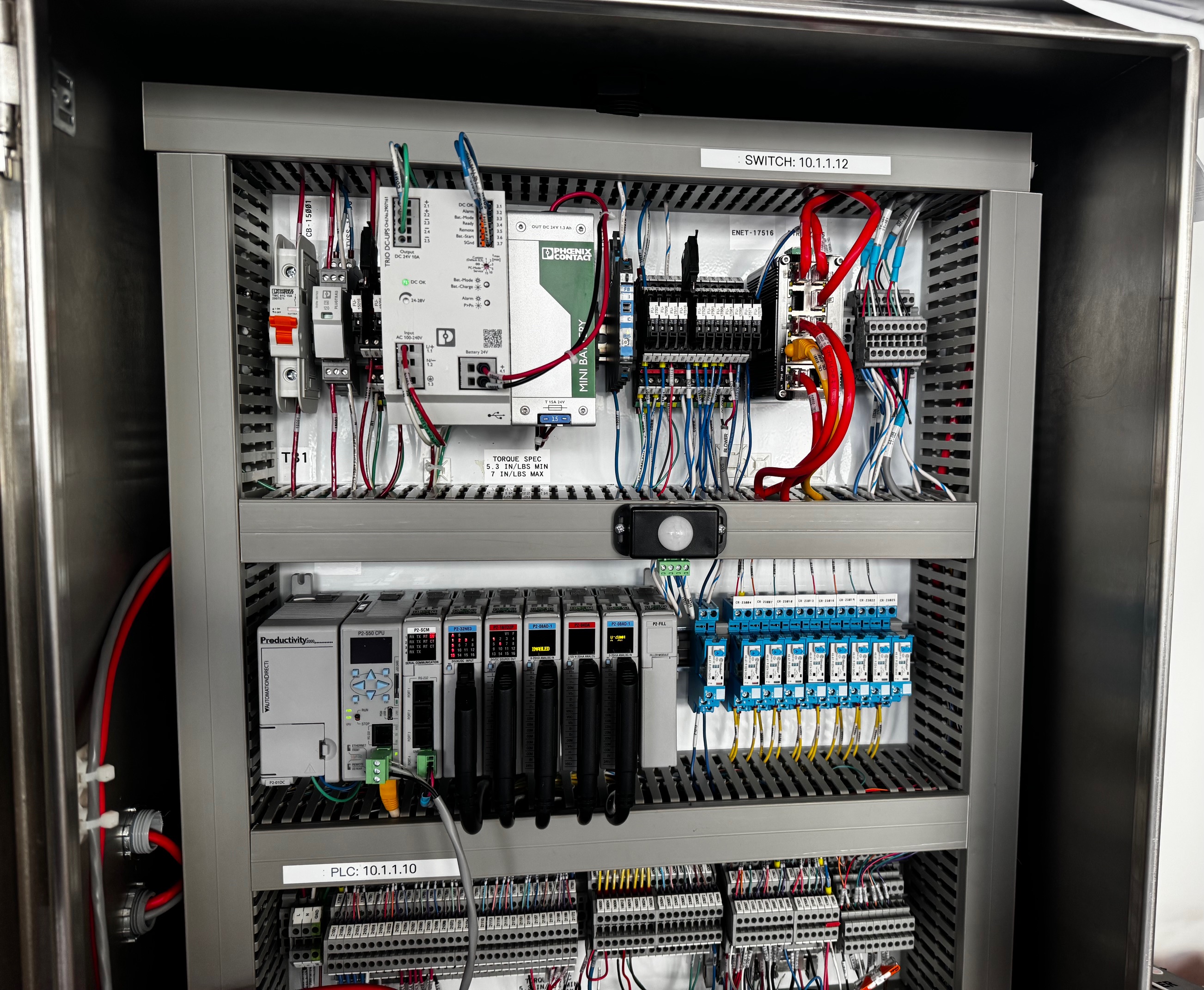
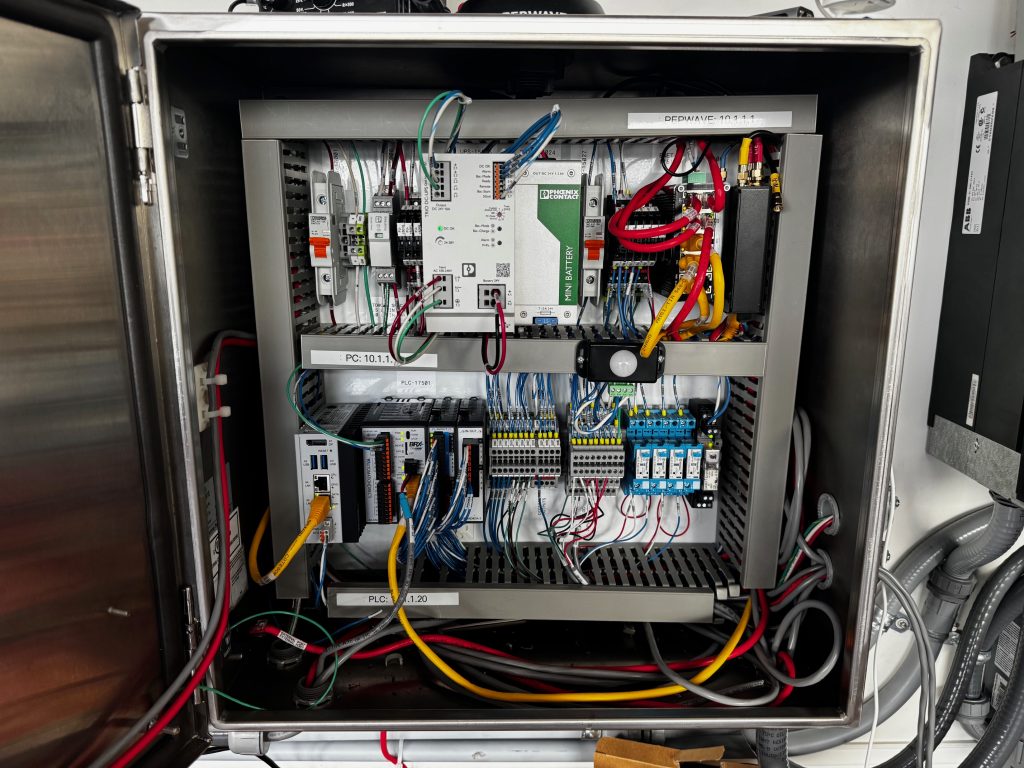
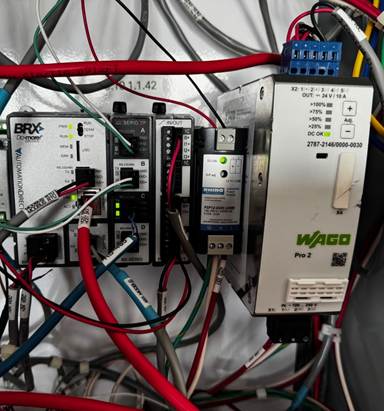
Figure 3: PLC enclosures include equipment such as switches, breakers, power supplies, the PLC, and even a motion sensor for simulating panel intrusion alarms. The wiring in the test lab BRX PLC cabinet is slightly messy by design to make troubleshooting as realistic as possible.
Every device in the lab is live and accessible. Students can change parameters, watch the response on the HMI, and—if the situation calls for it—deliberately misconfigure something to see what failure looks like. That freedom is impossible in a running plant, and it is where most of the real learning happens.
AutomationDirect components show up throughout the facility in less visible ways as well, from power supplies and terminal blocks to signaling devices and enclosures. Having a single source for a wide range of proven, cost-effective components simplifies sourcing and keeps the lab easy to maintain and extend as new training modules are added.
A Resource for the Entire Community
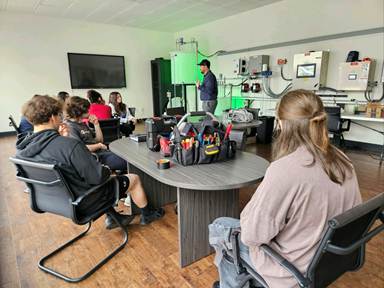
CoStream’s test lab has helped train public utility operators in automation concepts ranging from basic measurements to tuning a process control PID loop. This training platform has been useful to not only professional utility operators, but also college, middle school, and high school students as well (Figure 4). For instance, Lehigh University’s graduate engineering program has performed research on one of the patents CoStream has recently developed in the lab. Students field tested and verified the flow algorithm of a partial-pipe flow meter that uses a 3D-printed flume insert designed to fit a standard PVC pipe fitting. The device combined an accelerometer and a velocity sensor to produce measurements with less than one percent error in testing.
For many of the younger students, it is the first exposure to a career path they had never considered. The full spectrum of learning runs through the building, from a middle-schooler seeing a PLC for the first time to a doctoral candidate collecting data for a dissertation.
The innovation center has grown into more than a training space. It serves as a research platform and a proving ground for new ideas in instrumentation and controls. None of this would be sustainable without the AutomationDirect hardware and software products that hold up under constant use and are approachable enough for an operator to learn on and capable enough for a graduate researcher to publish on. The combination of a permanent, community-facing facility, a curriculum built around hands-on experience, and a well-chosen set of automation components has produced something that works for everyone who walks through the doors.
Small utilities, the students who may one day staff them, and the researchers advancing the state of the art all benefit immensely from having access to better tools and better training. The innovation center on main street is a step toward providing both.
All images courtesy of CoStream
Author Bio
Greg Martz is the founder of CoStream, a Pennsylvania-based Cloud SCADA provider focused on management, cybersecurity, and optimization of OT assets across a broad spectrum of industries. He spent more than three decades building a traditional industrial controls integration firm before turning his attention to the training, research, and fractional engineering work that CoStream now provides. More information is available at www.costream.tech.