

For decades, the HMI took the form of a panel-mount device at the machine or on the front of the cabinet. It was a natural fit for the era in which most factories, plants, and facilities were populated by discrete equipment, controlled locally. As facility design and usage models have changed, however, users seek the ability to support alternative approaches to automation. Enter the headless HMI. For the right application, a headless HMI can deliver a flexible, cost-effective, highly accessible alternative to traditional panel-mount devices.
Panel-Mount HMIs
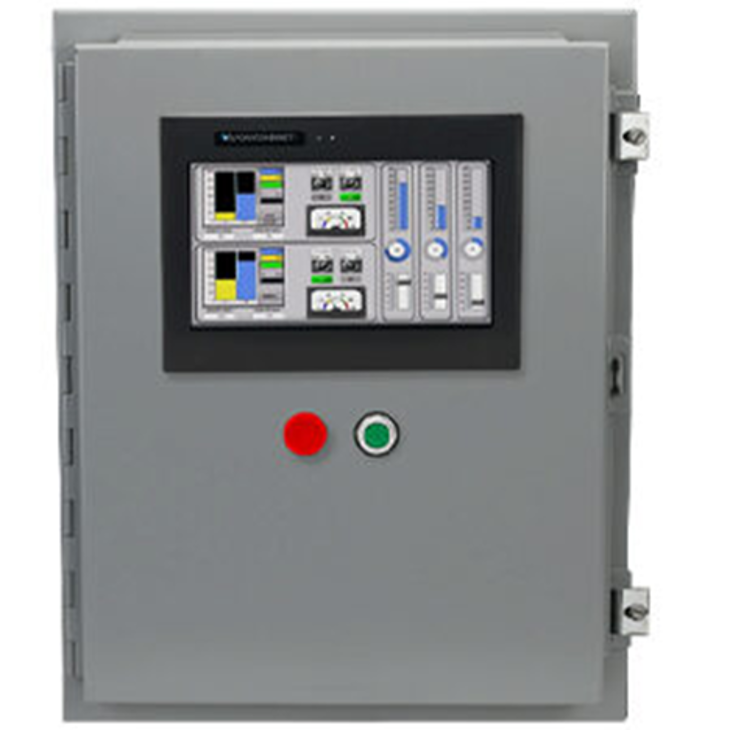
A panel-mount HMI is a single unit that consists of a logic module fronted by a display or touchscreen (see Figure 1). Panel-mount HMIs can be Installed directly on
the machine or on the front of the cabinet.
Pros
Panel-mount HMIs are familiar and widely used. The all-in-one design is simple to install – they just need to be wired up and connected to a power source. They’re available with resistive or capacitive touchscreens. Some HMIs can be accessed remotely, giving a certain amount of flexibility for monitoring, data acquisition, and even limited control or maintenance.
Cons
The panel-mount approach requires a dedicated HMI for each enclosure/ machine. This adds to the expense of installing new equipment. Screens are also limited to the dimensions and form factors available within a given product line. The integration of logic and output device also has its drawbacks. Physical touchscreens and displays can wear out or sustain damage. This is a particular risk in the punishing industrial environment, where equipment is routinely exposed to dust and contamination, temperature extremes, and shock and vibration. And I think we’ve all heard the tales of the operator who uses a screwdriver tip to
press a button on a touchscreen. Even for relatively superficial damage to the display or touchscreen, the entire panel-mount HMI needs to be replaced. This can quickly become expensive, especially if it leads to unscheduled downtime while a new unit is ordered and installed.
When to Choose a Panel-Mount HMI
Panel-mount HMIs definitely have a place on the factory floor. The units work well for operations mostly restricted to the local area, although some can be equipped for remote access. They are ideal for independent or isolated systems. But what about applications that require atypical displays/outputs/interfaces?
What about tightly internetworked production lines? For these, and many other, headless HMIs provide an alternative.
Headless HMIs
A headless HMI is a DIN-rail-mounted processing and communications unit that connects to an external display or remote digital device. It decouples
the logic device from the output device. As a result of this modular approach, headless HMIs lend themselves to a variety of implementations:
- External large-screen displays (Andon boards)
- Stand-alone touchscreens
- Off-machine device: headless HMIs can displays data on a computer, a smart phone, or a tablet.
Pros
The headless HMI approach offers a number of significant benefits.
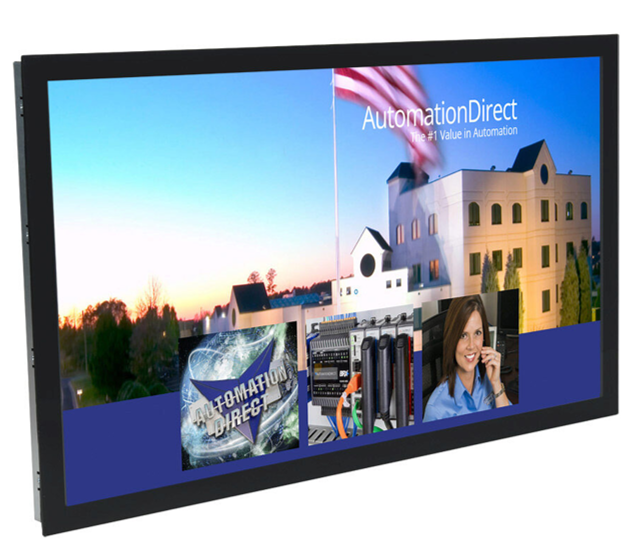
Display flexibility: Decoupling the logic module from the output device offers unparalleled flexibility to tailor the HMI to the application. Engineers are no longer limited to specific sizes and form factors of displays and touchscreens. A headless HMI can connect to any size HDMI monitor or TV supporting standard resolutions up to 1080p (see Figure 2).
Output-type flexibility: For control applications, a headless HMI can be connected to a touchscreen display or even a flat-panel display paired with a keyboard or pointing device. These logic devices are compatible with capacitive touchscreens, as well as conventional resistive touchscreens. In contrast with pressure-based touchscreens, capacitive touchscreens are low or non-contact. As a result, even high-use buttons don’t experience excessive mechanical wear that might otherwise lead to premature failure. Headless HMIs are compatible with remote digital devices like tablets, smartphones, or desktop computers via direct connection or wireless. They may be used primarily to extract and share information. The HMI software can also be run full-time on a computer plugged into a USB port. Perhaps most interesting, a headless HMI can act as a PLC-to-PLC bridge to aggregate data. For a simple system that just requires the main production machine to know its operational status, this can replace the need for a SCADA system.
Communications flexibility: Headless HMIs lend themselves to alternative HDMI architectures. They can be used with range extenders and splitters to, for example, send the data to an 18-inch touchscreen on the machine for the operators and mirror the image to a large overhead display showing production status and key information about the system.
The benefits of modularity: Separating logic and intelligence from display/interface options brings a number of benefits. Machine builders and integrators can take advantage of a single control architecture in the form of the headless HMI, connecting to a display/output type, size, location, and orientation best suited to each machine application. Decoupling logic from output also reduces hardware costs. Displays or other output devices can be updated or replaced without any changes to the headless HMI. This saves not just installation time but also time spent programming and configuring the logic.
The logic and intelligence of the HMI is sealed in the cabinet, not mounted on the front of the machine. This is great for harsh environments, protecting the unit from dust and contamination, temperature extremes, and mechanical shock and damage. There’s less risk to the logic unit – and to production – from a cracked display screen or broken interface. A machine with a headless HMI is a hardened machine. In addition, the headless HMI approach can be used to restrict access to machine controls. If a machine just has a headless HMI in the cabinet with no external display, then it can only be accessed by PC, tablet, or smart phone.
Individuals on the production floor have no way to gain access through a panel-mount screen.
Cons
There are a few trade-offs. Because headless HMIs require both the logic unit and the output unit, two items need to be purchased and installed. That said, depending on the choice of headless HMI and display, the combination may not be more expensive than a panel mount – there’s a crossover point. Even if the
headless HMI system requires a slightly higher capital expenditure, because of the benefits above, it can still lead to reduced operating expenditures. This is an important advantage for industrial automation equipment for which the electronics alone may have operating lifetimes of a decade or more.
Due to the HDMI connection and mounting, having the display separate from the enclosure can impact project troubleshooting. If the screen goes black, is it the HMI or the display? Discovering the answer just requires plugging the HMI into a different display.
When to Choose a Headless HMI
Headless HMIs are not better or worse than panel-mount HMIs, they are just different. Getting the most out of the headless HMI requires the right application. Headless HMIs are the optimal choice for:
- Locations with a high possibility of damage to a panel-mount HMI
- Applications requiring custom configurations
- Distributed environments involving separate machines and/or multi-site operations
- Applications that primarily require remote access
- Real-time monitoring control from a central locations
- Secure-access environments where physical access to the HMI should be prevented
Conclusion
Emerging architectures in the modern industrial automation environment increasingly require alternative solutions for HMIs. By decoupling the logic module from display/output interface, headless HMIs deliver unparalleled flexibility. Machine builders, integrators, and end-users can support custom configurations, distributed architectures, and remote monitoring and control. The logic module remains inside the cabinet, protected from harsh environments and unauthorized access. It is an engineering truism that there is no one perfect solution, just the best solution for the job at hand. For many applications, panel-mount HMIs are very effective solutions. For applications that require more, however, the headless HMI may be just the solution.