

Unmanaged+ industrial Ethernet switches apply key IT technologies—including VLANs, QoS, IGMP snooping, and more—in easily deployed OT-friendly hardware, all without any required complex management.
Today’s manufacturers are pursuing data analytics, AI-driven optimization, remote support, and enterprise-wide visibility, which means that their operational technology (OT) networks can no longer remain isolated from information technology (IT) systems. In an Industrial Ethernet June 2026 article titled Connecting Operations with IT using Industrial Ethernet Switches, Automation Direct’s Damon Purvis describes a new class of “unmanaged+” industrial edge switches that are helping end users obtain the performance and security they need, with simple plug-and-play options.
A connectivity balancing act
OT teams prioritize determinism, uptime, and simplicity, while IT teams expect segmented, policy-driven networks built on managed switching. Many end user organizations lack the staffing and budgets to deploy and maintain fully managed networking infrastructure end-to-end, yet unmanaged switches alone often provide insufficient security, traffic control, and diagnostic access at the OT/IT boundary between the factory floor and the enterprise.
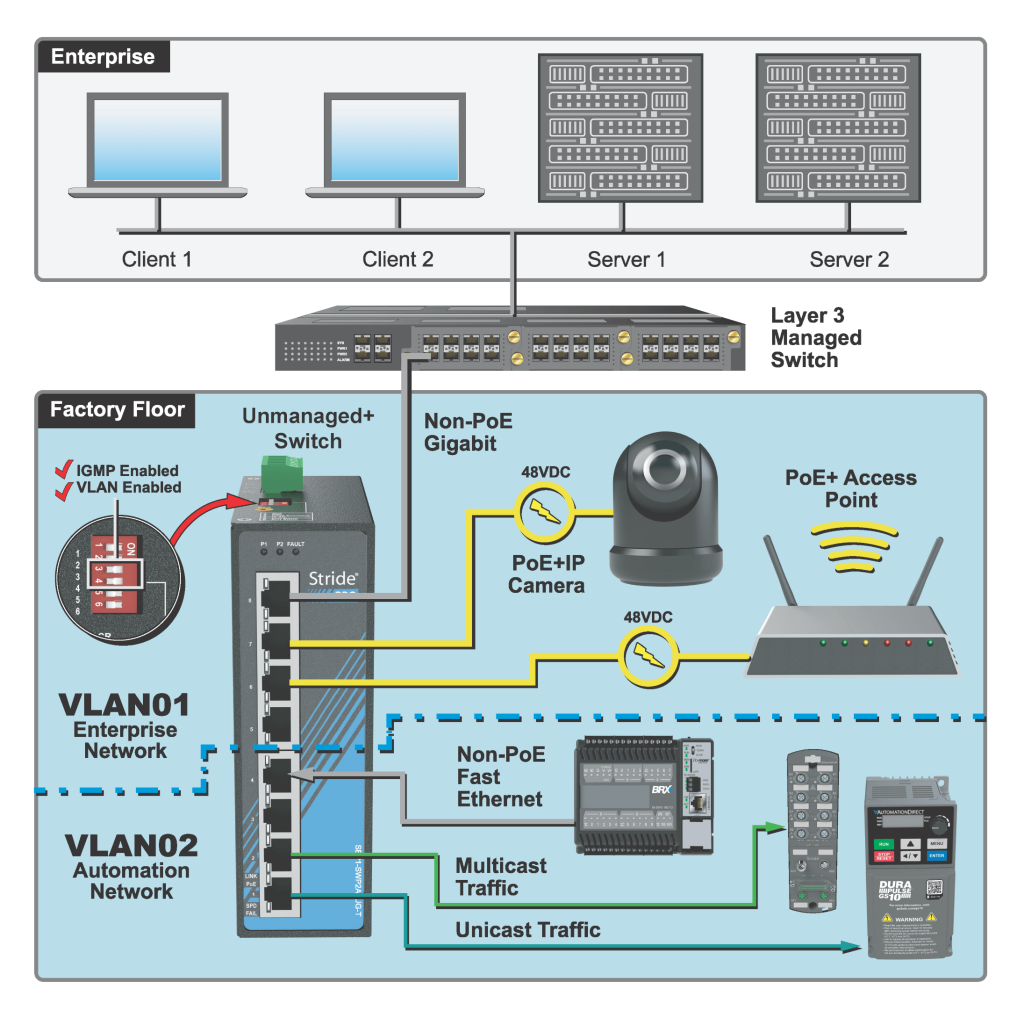
Industrial edge switches are positioned to close the gap between unmanaged OT hardware and fully managed IT switches. Some devices known as “lightly managed” or “lean” switches still require a degree of software configuration. However, another newer category, called “unmanaged+” switches, delivers friendly OT operation, while adopting the best IT practices for improved segmentation, performance, and visibility. All configuration is performed using simple DIP switches.
Tough and smart
AutomationDirect’s Stride PRO Unmanaged+ Ethernet Switch is purpose-built to help users integrate OT with IT. These switches provide industrial packaging and familiar power requirements: DIN-rail/panel mounting, IP30 metal housings, wide temperature ratings, 24 VDC operation, and enhanced immunity to electrical noise and surges. Some models include redundant power inputs, plus surge, spike, and reverse-polarity protection.
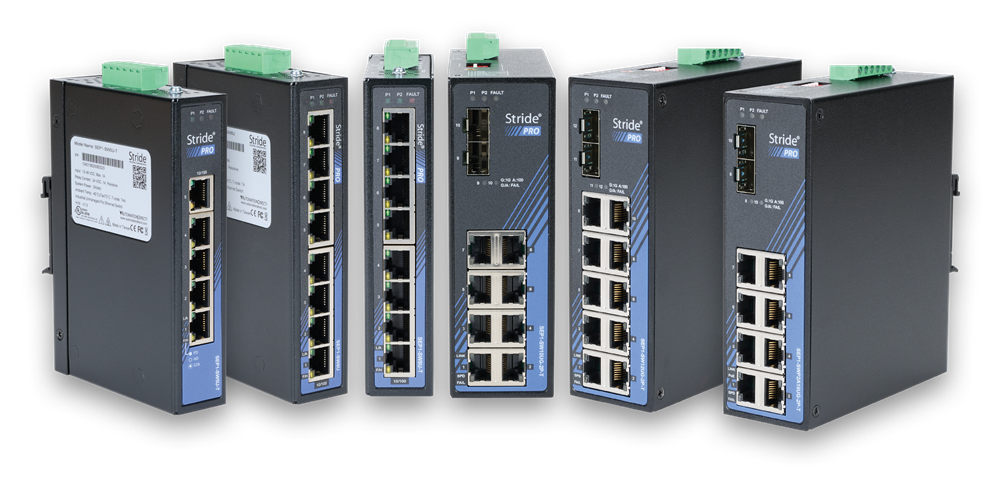
Functionally, unmanaged+ edge switches are purpose-tuned for common industrial Ethernet protocols (EtherNet/IP, PROFINET, Modbus TCP, etc.) and typical traffic patterns, such as high-volume multicasts from remote I/O. Core capabilities include support for Fast/Gigabit Ethernet and mixed media (copper RJ45 and fiber via SFP) to extend distance and reduce susceptibility to EMI. Power over Ethernet (PoE/PoE+/PoE++) simplifies installation of compatible devices by combining power and data on one cable, lowering wiring labor and enabling easier moves/adds/changes.
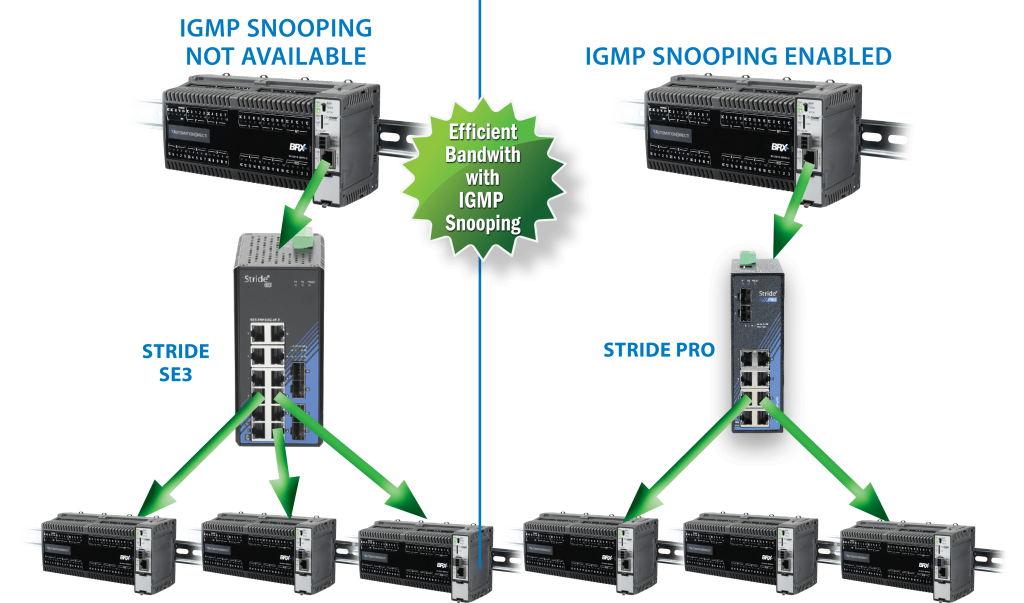
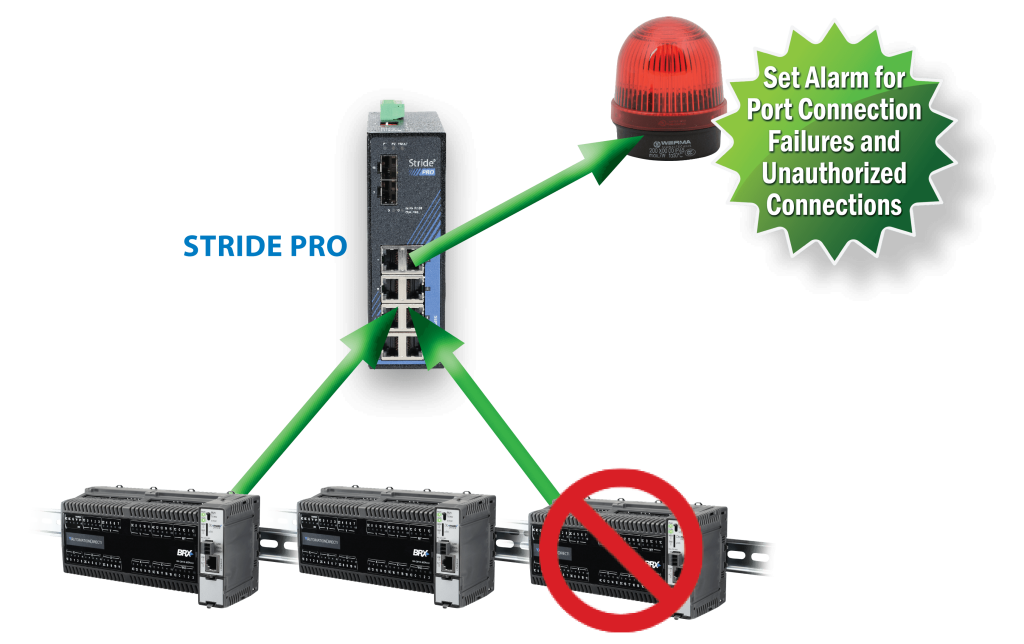
Performance considerations, such as quality of service (QoS), prioritize sensitive data, while broadcast storm protection prevents runaway traffic from degrading automation response. IGMP snooping is included, and it is especially valuable on control networks because it constrains multicast to only the ports with subscribing devices, reducing unnecessary load on PLCs, drives, and HMIs to improve overall bandwidth utilization.
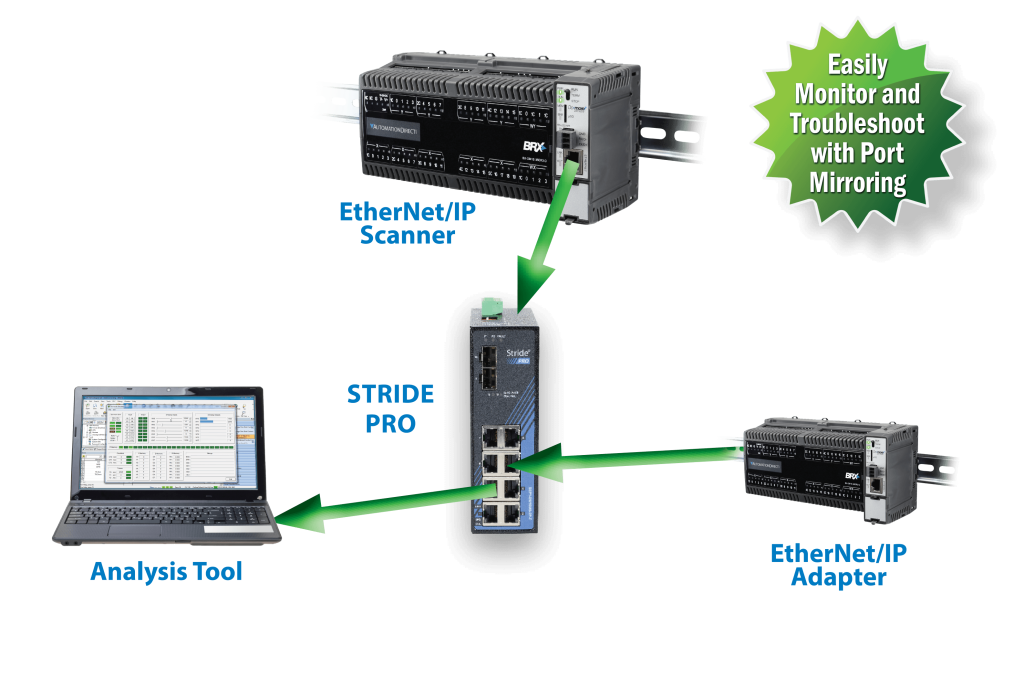
To align with IT security models without forcing fully managed switch complexity, port-based VLANs provide an easier way than hardwiring multiple physically separate networks to create isolated broadcast domains. For troubleshooting and monitoring, port mirroring provides non-intrusive packet visibility to a laptop or analyzer, and port disconnect alarms accelerate root-cause identification of broken cables, unplugged connectors, or failed devices—potentially integrating with existing OT signaling, such as stack lights or PLC/HMI alarms.
A simple step toward improved OT/IT integration
“Network utopia” can be reached in part by simplifying the OT/IT handoff: IT gains operational visibility, OT gains access to enterprise intelligence, and both benefit from the security and performance that are engineered into the edge, rather than bolted on afterward. Find out more about AutomationDirect networking and communications products.