

After running for decades on its original electro-hydraulic drive, Timber Lake Playhouse’s revolving stage system received significant behind-the-scenes AutomationDirect upgrades in 2007 and 2025.
By Ryan Poethke, ShowFab
Timber Lake Playhouse (TLP), adjacent to its namesake body of water and surrounded by woods and acres of farmland beyond, has been operating as a professional, non-profit summer theatre company in Mt. Carroll, Illinois since 1961. This 371-seat theatre sits on a 10-acre campus, which includes housing for its staff, plus the associated shops and administration facilities needed to put on multiple performances every summer. A nearby resort features tent, cabin, and RV camping, along with additional recreation facilities, providing a readily accessible audience in addition to locals or those who might make the trip for the day.
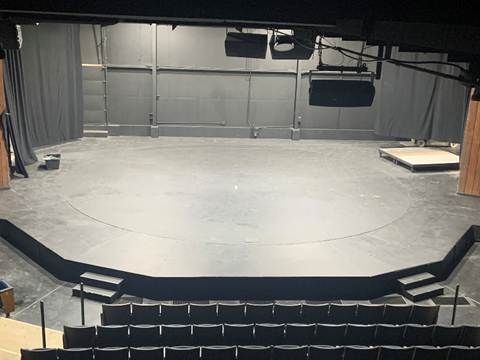
From an engineering perspective, what makes TLP especially interesting is its semi-thrust stage—extending into the audience—featuring a 36-foot diameter section of the floor that rotates under electromechanical control. This moving floor, known simply as a “revolve” in theatre terms, allows scenery to be set up backstage, then rotated into place for quick scene changes.
While the basic idea of a revolving stage seems fundamental, there has been significant progress in power transmission technology since TLP’s founding over 60 years ago. Accordingly, the theatre’s revolve has been the recipient of electrical and automation upgrades over the years to keep up with the times.
Changing Motor Technology into the 21st Century
Originally, the revolve system was powered by an electro-hydraulic drive, consisting of a 5HP electric motor as the input power source, driving a hydraulic pump. In turn, the hydraulic fluid was used to operate a hydraulic motor which turned the stage through a gearbox.
This worked for decades, but by 2007 this multi-part system was becoming unreliable and difficult to maintain. As such a critical part of the stage’s operation, this state of affairs was unacceptable. Complicating matters further, while TLP has adequate stagehands and technical staff for most day-to-day needs, it was much more difficult to access specialty technicians on a moment’s notice to support a balky stage drive system.
To improve this situation, I volunteered in 2007 to upgrade the system to full electrical control (Figure 1). Having spent a summer working at the Playhouse, and now being employed as a controls engineer for ShowFab, which specializes in set building and entertainment fabrication, I possessed the right combination of experience and expertise needed to make this upgrade.
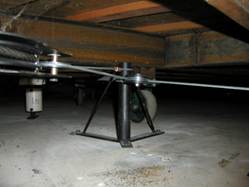
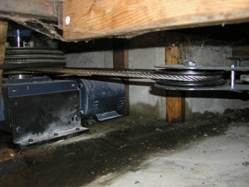
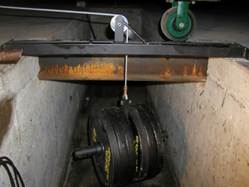
Figure 1a, 1b, 1c, 1d: These images show audience view of the “revolve” stage, as well as the electric motor, gearbox, and associated pulleys, cables, and tensioning weights, all hidden underneath the theatre’s stage revolve.
The original hydraulic drive was removed. In its place, an electrical-motor-driven gearbox was installed. Pulleys and sheaves, interconnected in part with a continuous loop of aircraft cable and tensioned by weights to establish the necessary friction, would transfer the rotational motion to the stage. This robust, and perhaps even medieval-looking, mechanical setup is entirely unseen by the audience, and quietly handles the system’s massive torque and moderate speed requirements without taking away from the experience of the play itself.
Key to the design would be implementing a way to control the 240V three-phase electrical motor in both directions at varying speeds, in an easy-to use manner. Based on practical experience, an AutomationDirect GS2 AC variable frequency drive (VFD) was chosen for the task. Because the site happened to have electrical power available in a somewhat uncommon 240VAC open delta 3-phase format, the VFD was readily configured to operate the motor, with a small user-friendly control panel, to spin the massive stage turntable in both a clockwise and counterclockwise direction without issue.
Motor Control Upgrades for 2025
This GS2 drive setup worked well for nearly two decades, but time takes its toll on any automation equipment. The VFD began experiencing some intermittent faults, which were easily cleared but created a nuisance for users. By 2025, the team realized it was time for a refit. Once again, I was able to volunteer my time to do this work. In addition, we would take this opportunity to provide a few safety and performance upgrades.
For this upgrade, I selected the latest version of the AutomationDirect VFD family, the GS23, which includes the same functionality as the older unit but also offers many enhanced features.
This modern VFD family uses three-phase power like the now-retired GS2s. But, of special importance for this project, the newer VFD can also accept a single-phase input to produce a three-phase output needed for velocity control, forward/reverse operation, and compatibility with the existing motor. The form factor of the new drive closely matches that of the older unit, allowing a new enclosure subpanel to be fabricated in advance to support a quick change-out (Figure 2).
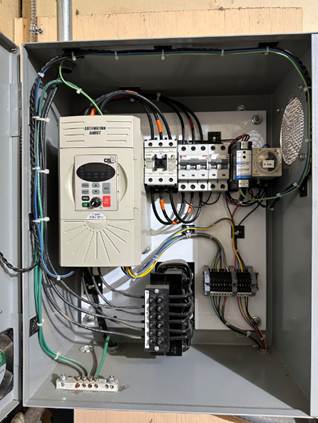
Figure 2: AutomationDirect VFDs (a GS2 in 2007, and a GS23 in 2025) have provided easy-to-use stage control for the TLP team, and a practical upgrade path away from a problematic hydraulic system. The 2025 upgrade eliminates the ongoing need for three-phase power.
While heavy industry commonly uses three-phase power to enable superior load carrying capacity for a given electrical load, the rotating stage was the last remaining piece of equipment at TLP that required three-phase power at the time of this installation. With this new drive in operation, the three-phase requirement could be dropped, simplifying the facility’s electrical distribution system.
Enhanced Operator Interface and Safety
In addition to the VFD panel, the system includes an operator console with a direction switch, run/stop buttons, a rotation speed potentiometer, indicator lights, and a fault reset button; many of these pilot devices, the enclosures, and other electrical and wiring components have been sourced from AutomationDirect (Figure 3).
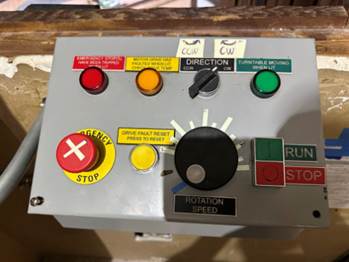
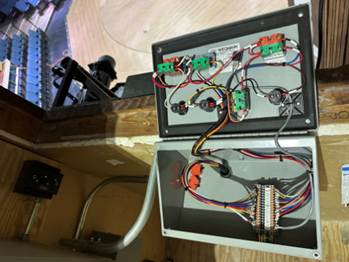
Figure 3: The operator console shown here uses several buttons, lights, and an e-stop button sourced from AutomationDirect to provide a simple way for stagehands to operate the stage revolve forward and backward at varying, yet reasonable, speeds.
Within the VFD panel, the latest upgrade now includes an AutomationDirect ReeR MOSAIC safety controller to monitor emergency stop (e-stop) buttons located at both the operator console and the stage manager’s position. If either e-stop button is pressed, the safety controller activates the VFD’s industry-standard safe torque off (STO) function, which, as further explained here, causes the drive motor to coast to a stop. The safety controller will also support the addition of other e-stop buttons in the future, which is a capability requested by TLP.
Another unique feature of the design regards how the cooling fan for the VFD enclosure is controlled. The goal was to turn the fan on whenever the VFD is started, and then to continue to run the fan for a period of time after the VFD is stopped to provide the desired cooling. This could be achieved with a hardwired relay, or with a small programmable logic controller (PLC), or by using the PLC function built into the G23 VFD. However, in this case it was determined that a practical way to achieve this control would be to use a safety controller auxiliary output. Designers appreciate it when they have multiple options for creating a solution.
The Show Must Go On
While one might say that the heart of any theatre company is the performers and staff, TLP’s unique rotating semi-thrust stage setup could be considered the facility’s marquee feature. Being able to rotate between multiple scenes with the push of a button and the turn of a knob gives stage handlers a massive advantage over having to quickly shuffle props during pauses in the action. However, this function must be reliable and maintainable. In this case, two upgrades performed years apart have progressively enhanced these characteristics, along with usability.
With these new improvements, the Timber Lake Playhouse is set up to reliably entertain audiences for decades to come, rotating the stage smoothly in either direction for scene transitions. What is going on behind—or more literally, below—the scenes may be interesting to stagehands and engineers, but when everything runs smoothly, the audience can get lost in the story itself, rather than thinking about how the “magical” rotating stage works.
All figures courtesy of Ryan Poethke
Author Bio
Ryan Poethke works for ShowFab in Fairfield, NJ as the company’s controls engineer. ShowFab supplies custom fabrication to Broadway, Film, TV, Museum, Fine Arts, Retail, Experiential Marketing and Cruise Ships industries. Ryan donated his time to help support Timber Lake Playhouse’s stage revolve project. He holds a BFA in Theater Design and Technology from UW-Stevens Point, and an MFA in Technical Production from Northern Illinois University.