

An automation upgrade allowed a professional summer stock theatre company to integrate its lighting systems, improving control while simplifying operations.
By Ryan Poethke, ShowFab
In the theatre, lighting sets the stage—creating an atmosphere and evoking mood even before the actors appear. Behind the scenes, however, there is far more than meets the eye: a fascinating technical framework that makes the magic possible. At Timber Lake Playhouse (TLP), a professional, non-profit summer stock theatre company in Mt. Carroll, IL, a lighting upgrade project utilized automation to seamlessly link the facility’s lighting systems, bringing greater control, efficiency, and creative flexibility to every performance.
Setting the stage
At a theater, several types of lighting work together to support both the onstage performance and behind the scenes operations. Show lighting sets the scene, illuminating the stage and actors. House lights cover the audience, playing a critical role for safe audience entry and egress and occasionally contributing to key moments during a performance. Work lights are utilized backstage to support behind the scenes preparation and technical work. Each lighting system fulfills unique roles, but there are times where they need to interoperate with each other.
TLP’s legacy lighting system uses multiple dimmer and switching racks, along with other elements, interconnected and communicating via the Digital Multiplex 512 (DMX) protocol. DMX is a serial communication protocol that originated in 1986. It transmits data at 250kbit/s, and is still widely used in the entertainment industry to control lighting parameters such as brightness, color, and fixture positioning for complex stage effects. Some of the lighting system uses the Streaming Architecture for Control Networks (sACN), which is Ethernet-based for controlling entertainment technology equipment. Communications gateways bridge the two protocols.
The stage lighting uses one set of operator/performance controls which had been upgraded over the years, but the house and work lights were operated by a specialized OEM controller actually intended more for architectural and office applications. As technology advanced in recent decades, TLP found their house/work lighting system in need of a major upgrade. The existing controller was installed in the early 2000s and became increasingly difficult to reliably support. Workarounds were in place, such as using a USB emulator to replace obsolete 3.5-inch floppy storage drives. Although the OEM supplier could offer some limited support, it quickly becomes costly and can sometimes limit the control and creativity of the on-site production staff. With this in mind, the search began for a solution to upgrade the controls in a robust fashion that would leverage the existing lighting infrastructure.
Casting call – identifying the ideal automation pieces
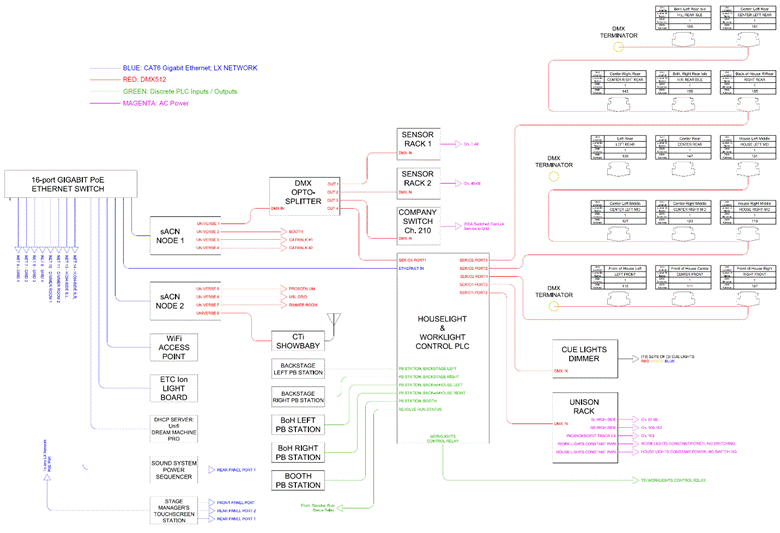
Typically, the house and work lighting simply uses traditional on/off buttons located throughout the facility, and a master control interface for the stage manager. However, there are times when the show lighting needs to control these systems, such as if the actors are in the audience area. Therefore, the new house/work lighting controller would need to support the DMX protocol so it could interact with the show lighting control. The system architecture includes a variety of components, a unique mix of commercial and industrial technologies spanning multiple generations (Figure 1). A critical design consideration was identifying a controller flexible enough to integrate with the many technologies, while also meeting demanding robustness and reliability requirements, and adapting to changing production needs.
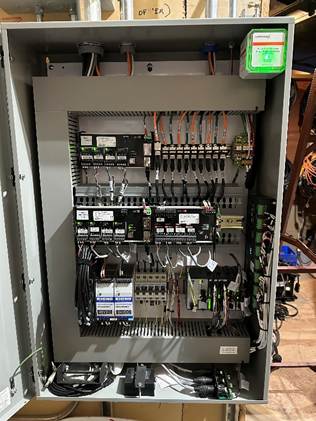
An industrial-grade programmable logic controller (PLC) meets many of the criteria for a project like this, however few PLCs natively support the DMX protocol. When availability, cost-effectiveness, and long-term support are considered, the list of viable options becomes even slimmer. Fortunately, the BRX PLC from AutomationDirect (Figure 2) fits the bill. An industrial-grade, stackable micro brick controller, the BRX features a compact, modular design that provides versatile capability while remaining budget-friendly when only the necessary I/O and communication modules are selected.
Lighting Designers primarily use a specialized PC-based lighting console to control stage lighting, sending DMX signals routed through the BRX PLC to the DMX racks and ultimately to the lighting fixtures. The PLC is equipped with multiple DMX serial ports to accomplish this. Most commonly, the stage DMX signals are simply passed through to the stage lighting. However, when it is occasionally needed, the stage lighting commands for house/work lights can be intercepted by the PLC and passed to those lights. Or, the stage manager can use the PLC to take control of and manage the house and work lighting. There is a show mode, and also a non-show mode supporting maintenance or when equipment, sets, and props are being loaded in or out.
The BRX PLC also needed to integrate with remote pushbutton stations used to invoke pre-configured lighting “scenes.” A discrete I/O module was added to monitor each of the five pushbutton stations for scene lighting, positioned in various locations throughout the facility. The design team used industrial-grade 22mm buttons from AutomationDirect to ensure durability and serviceability.
Taking creative control
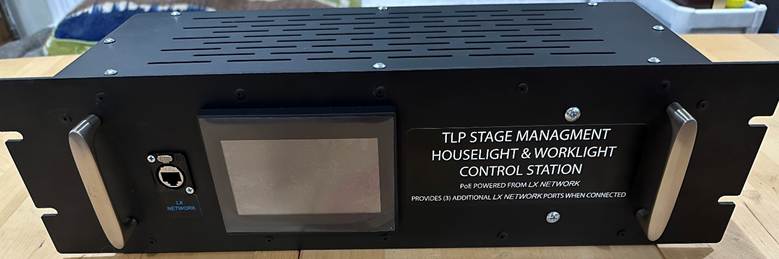
Of course, TLP does not expect the stage manager to have PLC programming experience to manage the house and work lights. Rather, a user-friendly control station was developed featuring a touchscreen human machine interface (HMI), the AutomationDirect C-more. For added convenience, this HMI was designed to be portable and is installed in a 19-inch rack (Figure 3) that is easily moved from backstage to the front of house for technical rehearsals, enabling the stage manager can make adjustments while watching the performance from the audience’s vantage point. One notable detail is that a power over Ethernet (PoE), and 24VDC PoE extractor are used for the HMI connection, providing both communications and device power via a very convenient single patch cord connection to the house network.
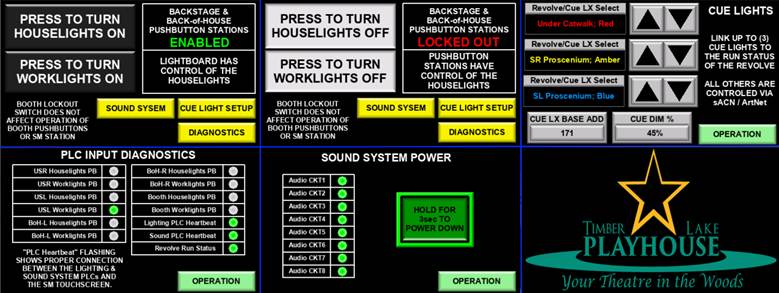
The HMI features interactive text, color graphics, and touch objects (Figure 4) that allow the house lights, work lights, and more to be adjusted. The HMI also helps with troubleshooting, providing a quick visual status of the PLC I/O as well as the sound system power. The HMI screen layouts not only allow for changes to be made, but they also help to error-proof operations. Safeguards such as a three-second hold prevent unintended changes caused by accidental contact, while a clearly defined sound system power up sequence reduces the likelihood of surging transients (that uncomfortable audible “pop”) that can occur when equipment is energized out of order.
Parts arrive right on cue
An unexpected concern during this project was part availability. The lighting upgrade took place during a time when the industrial global supply chain was in turmoil. Fortunately, this was not an issue because the BRX PLC hardware is designed, manufactured, and supported in the United States. The pricing and availability transparency on the AutomationDirect website made it easy to select products that met the project schedule.
In addition to the BRX PLC, many other critical project components were procured directly from AutomationDirect including the I/O modules, Rhino DC power supplies, Mersen surge protection, C-more HMI, and Fuji pushbuttons. All parts are standard, industrial-grade devices, which are very durable and much more cost-effective than a bespoke specialty OEM solution. Additionally, the ability to easily obtain the components from a single source helped limit the time spent managing and tracking orders from multiple vendors.
The next act
The BRX PLC has already proved to be highly extensible. To support TLP’s forty-five foot wide semi-thrust revolving stage, a system of cue light was added throughout the theater. The cue lights blink or illuminate in various colors to alert actors that the stage is about to move, allowing them to brace for movement before rotation begins. This feature is directly linked to the revolving stage automation, adding a layer of safety and convenience that was not previously possible.
The BRX PLC is easy to use with straightforward programming via the free Do-More Designer software which supports ladder logic and device-centric programming. The minimal learning curve is ideal for the theatre where production staff turnover seasonally and limited industrial programming experience is common.
With the abundant product and technical support resources available from AutomationDirect, a user manual has been developed so new staff can easily learn to use the system. Since many of the components in the lighting system are already Ethernet-enabled, there is a plan to expand the system to support remote connectivity in the future. While stagehands are trained to operate the system and engage technical support as needed, remote access will add a layer of backup support and confidence.
Curtain call
Ultimately, the lighting upgrade project was a success. Leveraging the existing lighting infrastructure helped keep costs down, and the BRX PLC proved to be a versatile performer by integrating smoothly with both commercial and industrial technologies. The addition of cue lights improved actor safety, while the use of industrial-grade components enhanced the overall reliability of the lighting effects. The flexibility of the new automation system and controls may not steal the spotlight, but will help ensure that TLP productions can continue to evolve and adapt to future creative and technical requirements.
All figures courtesy of Ryan Poethke
Author Bio

Ryan Poethke works for ShowFab in Fairfield, NJ as the company’s controls engineer. ShowFab supplies custom fabrication to Broadway, Film, TV, Museum, Fine Arts, Retail, Experiential Marketing and Cruise Ships industries. Ryan donated his time to help support Timber Lake Playhouse’s lighting upgrade. He holds a BFA in Theater Design and Technology from UW-Stevens Point, and an MFA in Technical Production from Northern Illinois University.